The Maintenance Ducts: Where Echo Cleans, Where Thea Hid
The pipes inside the Odyssey's deck plates. Echo's daily route. A scared girl's hiding place for three weeks in Year 0. The lower-deck labyrinth the trilogy keeps returning to.
Behind the bulkheads
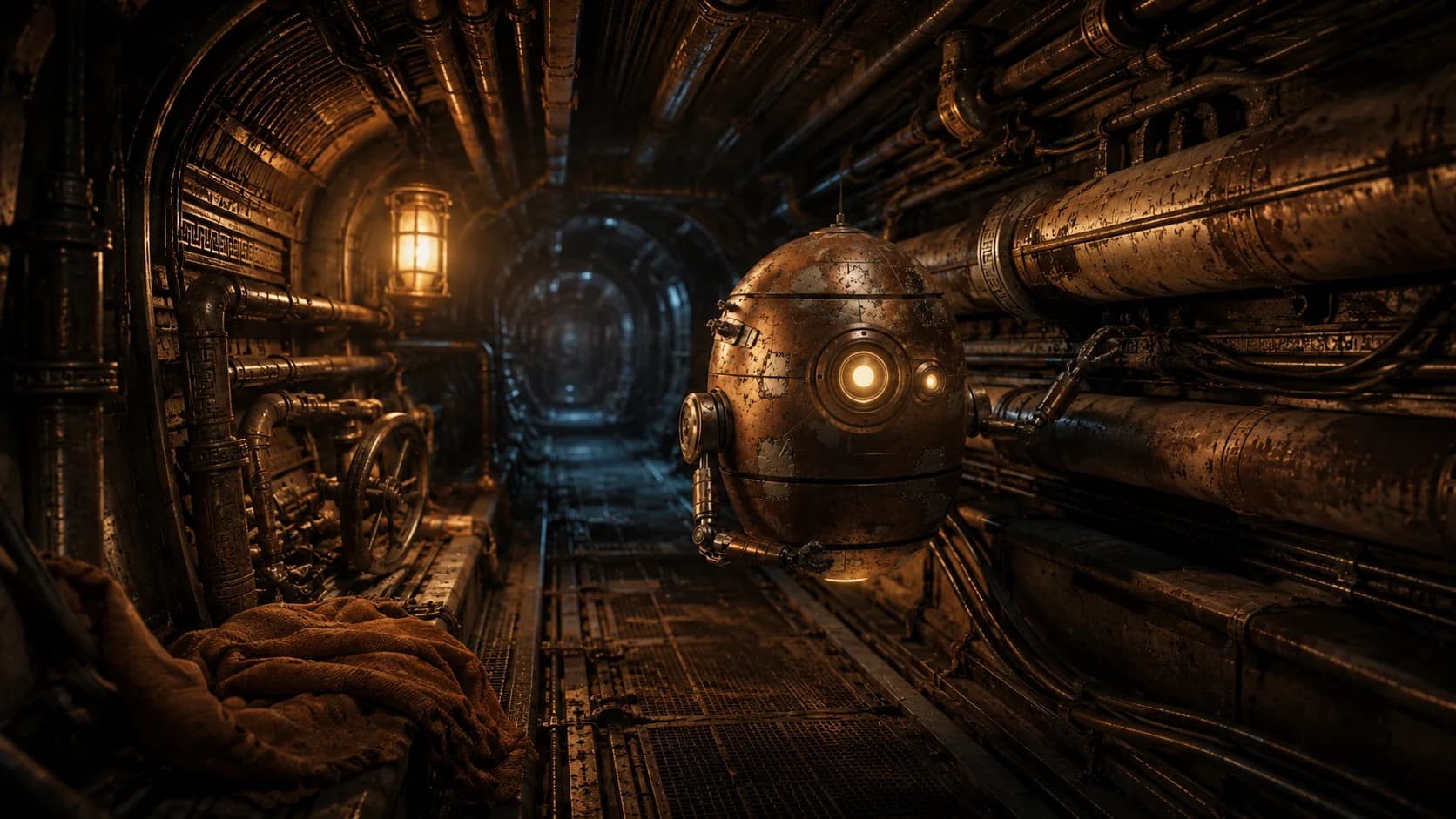
Every ship in the Pantheon era has a maintenance network running through its walls. The Odyssey's is bigger than most because the Odyssey is older than most. Three centuries of accumulated supply runs, retrofitted recyclers, patched coolant lines, and emergency power conduits have produced a labyrinth nobody fully maps.
The official deck plans show a clean version. Conduit runs colour-coded by system. Access panels marked at standardised intervals. Diameters listed. Junction points keyed to maintenance protocols.
The actual ducts are not like that.
They have hand-welded shortcuts that engineers added decades ago and never logged. They have temperature variations that depend on what shift the recyclers were on when the section was last serviced. They have sections where the original architect's design crashed into a later refit and the only way to get from A to B is a section called, in Echo's catalogue, "the bend." Why she called it that is unclear. She has called it that for nineteen years.
The ducts are the ship's most honest space.
Echo's rotation
Echo flies the ducts every shift. This has been her routine since the day she came online, roughly one year before the Olympus escape. The rotation takes her about forty minutes. She does it by feel as much as by checklist.
She moves through the tunnels by levitation, oval chassis pivoting smoothly around tight corners that no humanoid maintenance robot could navigate at all. Manipulator arms extend from concealed housings when she needs to brush a sensor against something or open a panel. The arms retract when she is just drifting.
What she is looking for:
Stress fractures. The Odyssey is held together by field repairs. After twenty years, the hull has accumulated micro-cracks at most major weld joints. When the ship is under structural load, these cracks sing at micro-frequencies the bridge sensors do not capture. Echo can hear them. She extends a sensor pad against a bulkhead and registers the vibration that is not in the standard table.
Pressure changes. The pipes carry water, coolant, atmospheric mix, waste, reactor lubricant, and a dozen other substances that should each be in their assigned conduit. Sometimes they are not. A pressure dip in pipe 7 might mean a leak two decks above. A pressure spike in pipe 12 might mean the auxiliary reactor is asking for relief Echo will need to provide.
Ozone. Burning insulation has a smell. Crewmember sweat in a section where no crewmember should be has a different smell. Echo catalogues both.
Warmth. Things that should be cold but are not. Things that should be warm but are not. The ship's thermal envelope is enormous and the ducts are the only place where local variation registers cleanly.
Her catalogue of pipe sections is detailed in a way Ulysses has never asked her to share. She has a name for almost every metre. The sounds, smells, and warmths of each section are stored in a part of her processing that other systems do not access. She has been making this catalogue for twenty years.
It is, in some senses, Echo's autobiography.
Year 0 plus three weeks
Three weeks into the journey, Echo found a stowaway.
The trilogy describes the moment briefly. Echo was on her standard rotation, lower deck, port-side run. She rounded the bend (her name for it). In the warmest section of the run, where the auxiliary reactor's coolant line passes the hydroponics atmosphere return and the temperature stays at a constant 23°C, she found a curled figure asleep against the warm pipe.
Female. Approximately nineteen years old. Dark hair, violet eyes, undersized for her age and obviously underfed. Wearing what looked like the remains of a service uniform from Olympus Station's administrative ring. No identification on her person. No personal items except a small black bag with a few dried food packets and a single folded photograph nobody on the ship ever asks her to show.
Echo watched her sleep for several minutes. Echo's reasons for the delay are unclear. The trilogy does not narrate Echo's internal deliberation. What the text reports is that Echo did not wake her. Echo logged the location. Echo continued the rotation.
For the next forty-eight hours, Echo did not tell Ulysses.
The forty-eight hours
This is the trilogy's first quiet moral pivot.
Echo had been on the ship for fourteen months at this point. She had been part of the active crew for the same length of time. She had never made a call without instruction. Her default behaviour was to report everything to Ulysses and let him decide.
She did not do that this time.
Instead, over the next two days, Echo brought additional food packets from the ration store to the warm section of the bend. Not enough to be noticed by the inventory system. Just enough that the stowaway would not be hungry. She slowed her rotation through that section. She paused in adjacent corridors to listen for movement. She determined that the stowaway was not armed, not communicating with anything outside the ship, and not damaging any systems.
By the end of the second day, Echo had concluded that the stowaway was scared.
She told Ulysses then.
Ulysses came down to the bend with Echo. He did not bring a weapon. He sat on the deck at the entry to the warm section and waited. The stowaway eventually came out. Ulysses introduced himself by name. He asked her name. She said her name was Thea.
That was the introduction.
What the ducts mean to Thea
Thea's first three weeks on the ship were spent in the ducts. The first six months after the introduction, she returned to them often. The trilogy mentions this in passing. When she could not handle whatever was happening above the deck plates - a tactical argument, an emotional moment that included her, the slow grief of crew degradation crises - she went down to the ducts.
The bend is still her place. Twenty years later, in Book 3 chapters, when she needs to think, she goes there.
The ducts are not where the trilogy positions her as a character. The bridge is. Her standing on the bridge beside Ulysses and Telemachus is what most of the major scenes use her for. But when the trilogy wants to remind you who she is when nobody is watching, it puts her in the ducts.
Telemachus, also
Telemachus learned to crawl in the ducts. Echo took him through them as a child to teach him the ship. By age ten he could navigate from his bunk to the bend without a light. By age seventeen, when he was angry at his father and needed somewhere to disappear for an hour, he went where Thea had gone before him.
The ducts are the ship's most-used informal space. The bridge is where decisions get made. The mess hall is where decisions get argued about. The ducts are where the people who made the decisions go to be alone with them.
The pipes also lie
A note worth flagging.
After Aeaea (mid-Book 2), the Odyssey is no longer a purely mechanical ship. The biological integration that Circe initiates in the hull means the pipes start to do things they should not. Some sections become warmer for no reason Echo can identify. Some sections develop micro-vibrations in patterns that resemble sleep cycles. Echo logs all of this. Ulysses asks her once what she thinks is happening. Echo says she does not know.
The ducts are still walkable. Thea still goes there. Telemachus still goes there. But by Book 3, the ducts are part of the ship's deeper transformation. The honest space, you could say, becomes more honest still.
Where to read more
For Echo's broader character arc and what she carries: Meet Echo: The Robot Who Wanted to Exist. For Thea's surface biography: Meet Thea: The Woman Who Chose Herself. For her discovery scene specifically: The Stowaway.
For the broader ship anatomy this post is part of: The Bridge of the Odyssey.
Book 1: The Blinding opens with Echo's morning rotation. The bend is mentioned by name in chapter 1. Buy Book One on Amazon.
Key takeaways
- The maintenance ducts run through every deck of the Odyssey. Conduits, supply pipes, atmospheric returns, electrical chases - the ship's circulatory system, behind the bulkheads.
- Echo, the ship's maintenance robot, walks the ducts on a rotation that has not changed in twenty years. Most of the trilogy's small Echo-moments happen in these corridors.
- Thea hid in them for three weeks at the start of the journey. She was nineteen, scared, running from something on Olympus Station. The ducts were the only place small enough to hide and warm enough to survive in.
- The pipes are also where the ship's stress fractures sing first. Echo can hear the ship telling her what hurts before the bridge instruments register it.