The Bridge of the Odyssey: Command Chair, Worn Armrest
Ten years in the same chair. A dent in the right armrest where Ulysses Theron's elbow has rested. Soft amber console-light. The most-occupied space on the ship.
The room itself
Walk into the Odyssey's bridge and the first thing you notice is the cold.
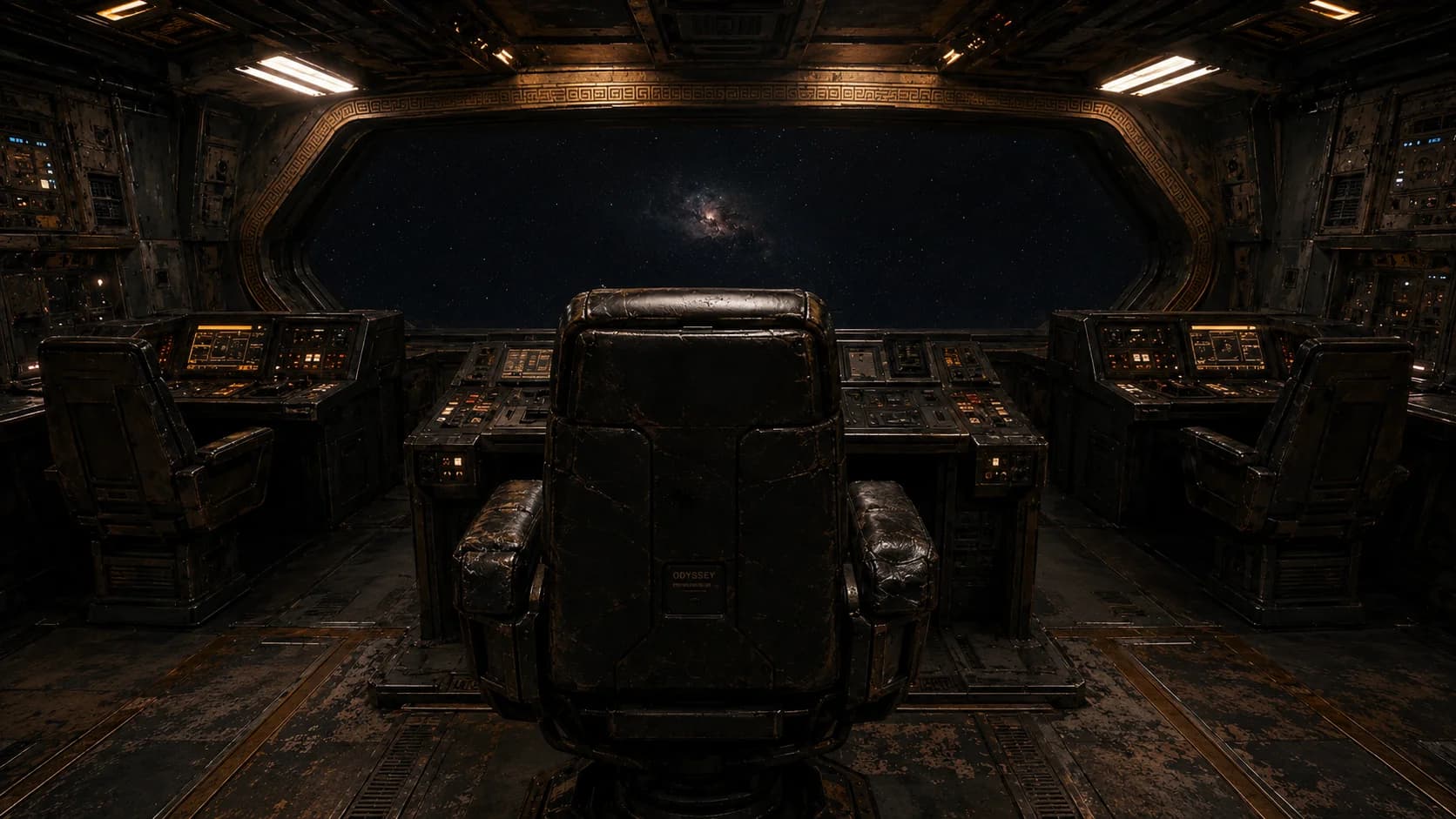
The bridge is the coldest compartment on the ship. The electronics prefer it that way. Most of the bridge's hardware is original to the ship's commissioning, three centuries old now, designed for thermal envelopes that were standard at the time and have since fallen out of fashion. The compartment is held at 16°C, which is uncomfortable for sustained human occupation. The bridge crew has learned to dress in layers.
The lighting is warm white under stable power. It shifts to amber when the reactor is straining. Most of the journey it has been amber. The bridge crew has learned to read the amber as a measure of how the ship is feeling.
The deck plates carry the Greek meander pattern etched in bronze along the bulkhead trim. The pattern is decorative. It is also, where the trilogy's central technological idea applies, functional. Some of the bridge's data buses route through the meander lines. Few people on the ship know which.
The room is small. Eight metres by five. Four primary stations and one auxiliary. The viewscreen takes up most of the front wall. Behind the command chair, three stations face inward. The compactness was a design choice from the era when bigger bridges had been tried and found wanting. The Odyssey came from the design generation that valued tightness.
The command chair
Ulysses Theron has been sitting in the command chair for the full twenty years of the journey.
The chair is bolted to the deck at the geometric centre of the bridge, facing the main viewscreen. It is upholstered in synthetic leather that the Pantheon's standard supply chain stopped manufacturing about fifteen years ago. The Odyssey's quartermaster has refurbished the chair twice during the journey. Each refurbishment lasted about five years before the wear became visible again.
The wear has a specific pattern.
Ulysses rests his right elbow on the right armrest when he is thinking through a tactical problem. The elbow rests on the leather in a way that, over time, presses a depression into the material. By the time the first refurbishment happened, the depression was about four centimetres deep and visibly indented in even neutral lighting. The quartermaster replaced the leather. Within three years the depression had reappeared in the same place. The quartermaster replaced the leather again. The depression came back.
By Book 1, the depression is, in the words of Echo's maintenance log, "the chair's permanent feature."
It is also the most personal mark on the ship.
The crew complement
The bridge is rarely more than three people at a time. The Odyssey's active crew has been small throughout the journey - usually between three and eleven, depending on which crew degradation crises have produced which forced wakings. Of the active crew at any given time, only some are bridge-rated.
The constants:
Ulysses. Almost always present. His command shifts during the active phase of the journey often ran sixteen hours. He delegated only to people he had personally trained.
Echo. Almost always present. She handles sensor cross-correlation, ship-systems status, and the running interpretation of what the ship is saying through its sub-frequencies. Her station is the secondary one to Ulysses's left.
Telemachus. From age fifteen onward, on rotating shifts as Ulysses trained him in fleet command. By Book 1 he is a competent bridge officer. By Book 2 he is occasionally trusted with the command chair while his father sleeps.
Thea. From year five onward, on the same training rotation. She does not have Telemachus's depth of preparation - she came to the ship as a stowaway and had no fleet background - but Ulysses recognised early that her tactical instincts were unusual. By Book 2 she stands a routine shift.
Petrov. Engineering oversight, killed at Scylla in Book 2. After his death, engineering oversight rotates between Echo (who covers the technical side) and Ulysses (who covers the decision side).
The bridge has never, in its twenty years of journey, held more than seven people at once.
Athena's presence
Athena is on the bridge in the way she is on the bridge.
Her distributed consciousness in the Odyssey's network is densest in the bridge subsystems. The reason is mechanical: the bridge is where ship-state information is most concentrated. Sensor data, navigation data, comm data, reactor-status data, all of it terminates here. If Athena wants to know what is happening on the ship, the bridge is where the information goes.
She can hear most of what is said on the bridge. She can read the sensor logs in real time. She can, when the situation requires it, write small changes to the ship's behaviour that look like coincidence from the outside.
She does not always respond.
The constraint is her status. She is a fugitive deity hiding from the rest of the Pantheon. Direct interventions risk revealing her position. Most of her bridge work is therefore indirect, deniable, and delivered through systems other than direct comm. Sensor readings that turn out to be slightly more accurate than they should be. Reactor warnings that come thirty seconds earlier than the instruments would normally have caught them. Echo's processing receiving subtle nudges that Echo herself might not consciously register.
The bridge is the room Athena watches from. It is not the room she lives in.
What the bridge sounds like
The bridge has a sound profile that is consistent enough to be diagnostic.
The reactor's bass hum is two hertz lower than spec, has been for ten years, and forms the background drone of any bridge shift. Echo's auxiliary processing, when active, produces a faint warble at around 800 Hz that the human ear processes as benign. The atmosphere recycler in the corner runs a four-tone cycle every ninety seconds.
When something is wrong, the soundscape changes before anything else does. The reactor's hum drops or rises out of its normal band. Echo's warble becomes a steady pitch. The atmosphere recycler stops cycling cleanly. The crew has learned to register these shifts pre-consciously - before any instrument has flagged a warning, the bridge crew already knows something has moved.
This is one of the trilogy's quietest details about command. The instruments tell you what has gone wrong. The room tells you a few seconds earlier.
A working life
Across twenty years of journey, more decisions have been made on the Odyssey's bridge than in any other compartment on the ship. The blinding of Polyphemus was ordered from this chair. The acceptance of Aeolus's gift, and the catastrophic loss of it, was logged from this station. The descent protocol that Ulysses ran to consult Tiresias was initiated from this room. The decision to enter Scylla's corridor rather than Charybdis was made on this deck.
The chair has been sat in. The armrest has been worn. The bridge has heard most of the trilogy's important sentences.
It is not a glamorous room. It is the most-occupied room on the ship.
Where to read more
For the ship's most-honest space (the opposite of the bridge): The Maintenance Ducts: Where Echo Cleans, Where Thea Hid. For the captain who sits in the chair: Meet Ulysses Theron: The Admiral Who Blinded a God. For the goddess who watches from the network: Meet Athena: The Goddess Who Chose Treason.
For the broader trilogy timeline of bridge events: Twenty Years on the Odyssey: The Master Timeline.
Book 1: The Blinding opens with a bridge scene. The armrest dent is mentioned in chapter 2. Buy Book One on Amazon.
Key takeaways
- The Odyssey's bridge is a small, dry, deliberately cold compartment. Best conditions for electronics. Worst conditions for sustained human occupation.
- Ulysses Theron's command chair has a worn dent in the right armrest where his elbow has rested for a decade. The dent is the most personal mark on the ship.
- The bridge crew at any time is rarely more than three: Ulysses, Echo, and one of either Telemachus or Thea, depending on shift.
- Athena's presence in the ship's network is densest in the bridge subsystems. She can hear most of what is said there. She does not always respond.