The Sirens in the Odyssey: What They Really Represent
Beautiful voices on a rocky island piled with the bones of dead sailors. Homer's most haunting threat. What the Sirens actually are, what they sing about, and why their image has survived 3,000 years.
What Homer wrote
In Book 12 of the Odyssey, Odysseus's ship must pass an island where the Sirens live. Circe, on Aeaea, has warned him about what awaits him.
The Sirens are not creatures that physically attack ships. They do not have weapons. They do not throw rocks. They do not call up storms. They simply sing.
The songs are unbearable. Any sailor who hears them is overwhelmed by a compulsion to sail toward the island. The compulsion overrides all other considerations: navigation, survival, the danger of the rocks around the island, the visible piles of bones in the meadow next to the Sirens' singing rock.
The compulsion is total. Sailors who hear the song will, given any opportunity, steer their ships into the rocks. They will untie themselves from masts. They will throw themselves into the sea. They will do whatever is necessary to reach the source of the singing.
They die. Their bones pile up. The meadow next to the rock is, in Homer's description, full of putrefying corpses. The Sirens sing on.
The technical workaround
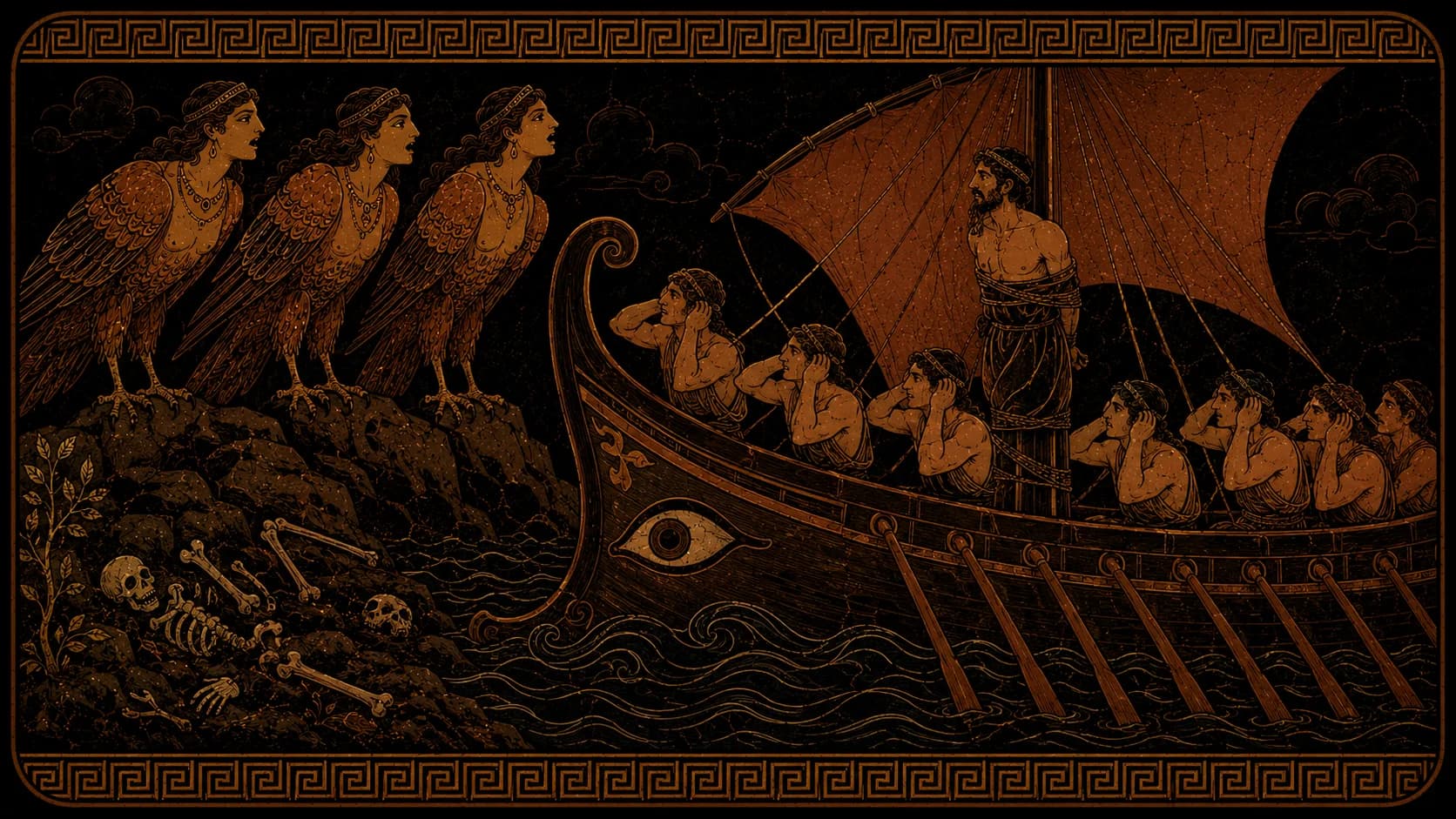
Circe has given Odysseus the protocol that allows safe passage. The crew must block their ears with beeswax so they cannot hear the song. Odysseus himself must be tied to the mast so he can listen without being able to act on the compulsion.
Odysseus follows the protocol. His crew, with sealed ears, rows steadily past the island. Odysseus hears the song. He immediately begs to be untied. He struggles against the ropes. He makes gestures at his crew. They cannot hear his pleas because their ears are blocked. They do not even know he is trying to speak.
The ship passes the island. The danger ends. Odysseus, restored to himself once the song fades, is grateful for the ropes.
This is one of the Odyssey's clearest examples of the principle that you cannot trust your own future self under certain conditions. Sober Odysseus prepares for the moment when intoxicated Odysseus will be unable to think clearly. The preparation works. The compulsion does not get its way.
What the songs say
The content of the Sirens' songs is more interesting than the popular image suggests. They do not sing wordless beautiful melodies. They sing about knowledge.
The Greek text is specific. The Sirens promise to tell Odysseus everything that happens on earth. They promise to tell him the truth about Troy, about the great deeds of the Greek heroes, about the things he has not been able to learn. They promise omniscience.
This is what makes Odysseus, specifically, vulnerable. He is, in Greek tradition, the most curious of the Greek heroes. He is the one who wants to know things. He wants to see the Cyclops's land out of curiosity. He wants to hear the Sirens out of curiosity. The Sirens know exactly which kind of intelligence to target.
The seduction is intellectual rather than romantic. The Sirens do not promise love. They promise information. Odysseus's compulsion is the compulsion of a mind that cannot resist learning what it does not know.
The bones in the meadow are the bones of every sailor who could not resist that promise.
What they represent
The metaphorical readings of the Sirens are numerous. A short tour:
In the classical tradition, the Sirens represent any irresistible desire that destroys the desirer. The image is sufficiently flexible to apply to whatever the reader's current obsessive risk is.
In the Stoic tradition (especially Cicero, who quotes the Sirens scene approvingly), they represent the temptations of fame and knowledge that distract the philosopher from virtue.
In medieval Christian readings, they represent worldly pleasures generally, and the danger of being seduced by them away from spiritual goods.
In Renaissance readings, especially Dante's brief Inferno mention, they represent the false sweetness of sin, which appears beautiful until you are too close to escape.
In Romantic readings, they represent the artist's compulsion toward beauty even when the beauty is dangerous. Heine and others use the image this way.
In psychoanalytic readings (Freud, indirectly; Lacan, more directly), they represent the death drive: the part of the psyche that desires its own dissolution.
In modern feminist readings, they represent the way ancient texts pathologise female voices and figure them as threats to male autonomy.
All of these readings are available. None of them exhausts the image. The Sirens persist as metaphor because the metaphor flexes.
Why they are not mermaids
The common confusion of Sirens with mermaids is post-classical. In Homer and most ancient Greek sources, Sirens are bird-bodied women. Human heads. Human torsos. Bird wings, legs, and tails. The early Greek art depicts them this way clearly.
The mermaid identification develops in medieval European tradition, partly through Christian re-interpretation of the Sirens as sea-temptations and partly through fusion with separate aquatic-monster traditions from northern European myth. By the Renaissance, the bird-Sirens of antiquity have been largely replaced in popular imagination by the mermaid-Sirens of modern adaptation.
The fish-bodied Siren is now so dominant that most modern readers, asked to describe a Siren, will describe a mermaid. This is, technically, wrong. It is also so culturally entrenched that arguing against it is mostly a waste of effort.
For accuracy: bird-bodied. For cultural recognisability: mermaid. Choose your battles.
The Ulysses Universe version
Our Sirens are a signal that rewrites memory. Not voices. Not creatures. A broadcast that propagates through a defined region of space and surgically alters the memory architecture of any listener within range.
The danger, in our version, is not death. The danger is forgetting. Listeners survive the encounter physically. They emerge with substantial portions of their personal history rewritten or deleted. They cannot tell what has been changed because the version they have is the version their brain is currently storing as canonical.
The structural function is preserved from Homer. The Sirens are an obstacle that requires technical workaround. They cost the journey something. They are not defeatable in the heroic sense.
We've written about our version at length in The Sirens: A Signal That Rewrites Memory.
Where to go next
For our location piece on the Ulysses Universe Sirens, The Sirens: A Signal That Rewrites Memory. For the Pantheon-side character profile, Know Your Gods: The Sirens. For the goddess who briefs Odysseus on how to survive them, Circe in the Odyssey: Witch, Goddess, or Something Else?.
The Ulysses Universe trilogy contains the Sirens encounter in Book 2. Buy Book One on Amazon to start at the beginning.
Key takeaways
- The Sirens in Homer are not mermaids. They are bird-bodied women whose songs are so beautiful that listeners cannot resist sailing toward them, where they die on the rocks of the Sirens' island.
- What the Sirens sing about, specifically, is the listener's deepest knowledge. They promise to tell you everything you ever wanted to know.
- Odysseus survives by having his crew block their ears with wax and tying himself to the mast so he can listen without acting on the urge to go to them.
- Modern readings treat the Sirens as a metaphor for any irresistible desire that destroys the desirer. The original Greek treats them as literal supernatural threats.