Zeus: King of the Gods and Everything Wrong With Power
King of the Olympians. Wielder of thunder. Father of half the Greek heroes. Patron of justice. And the most morally complicated Olympian when you read closely.
What Zeus rules
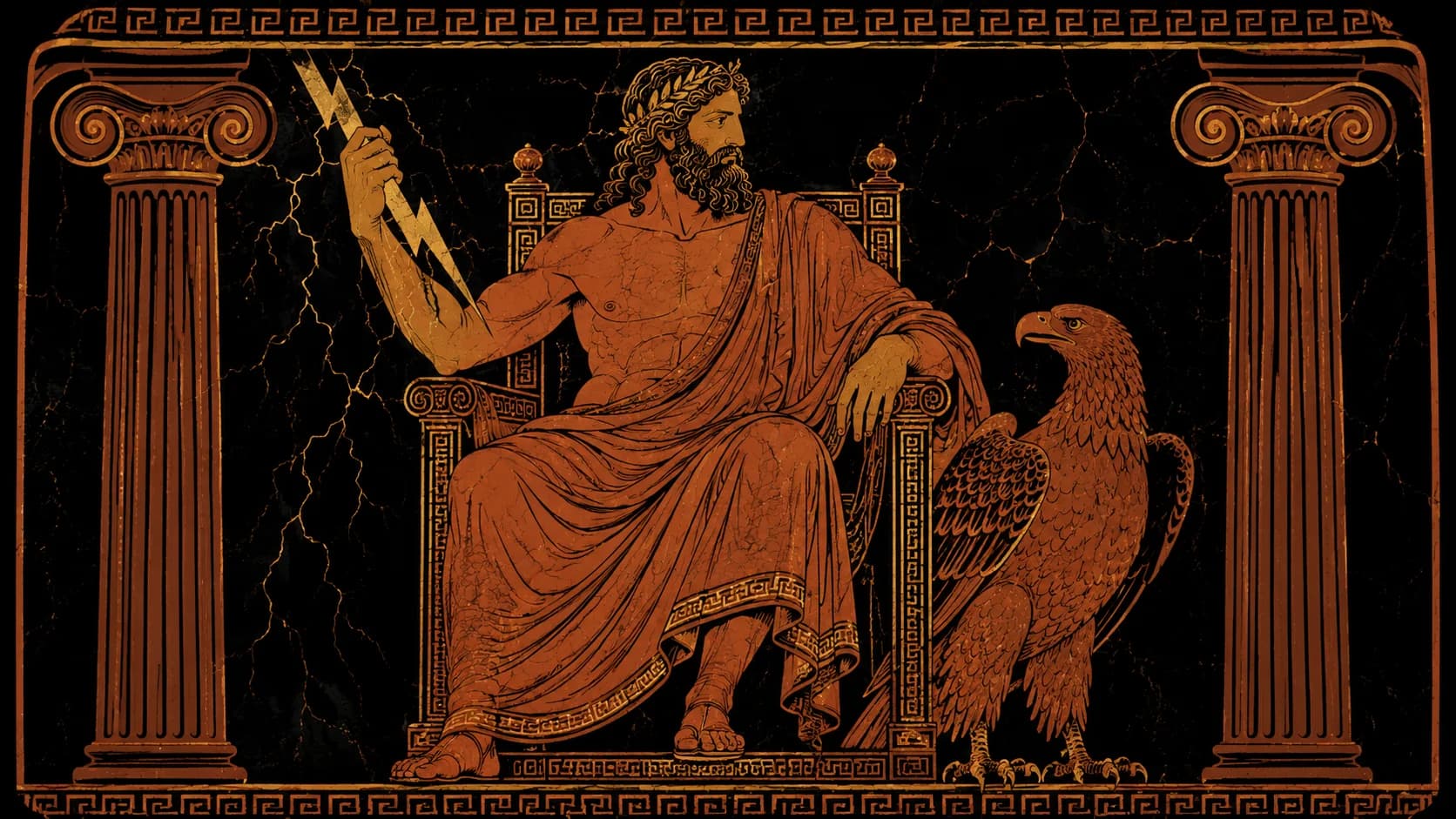
Zeus is the king of the Olympian gods. His domain is multiple: the sky, weather phenomena (especially thunder and lightning), the regulation of the cosmic order, the enforcement of oaths, the supervision of hospitality (xenia), and the supreme political authority of the divine council.
In ancient Greek practice, Zeus was invoked for matters of fairness, kingship, the protection of strangers, the validity of oaths, and the regulation of weather (especially the rain that mattered to agriculture). He was the most-worshipped male Greek god across the entire Greek-speaking world.
His symbols are the thunderbolt, the eagle, and the oak tree. His Roman counterpart is Jupiter. His Indo-European origins (in the proto-Indo-European sky-father Dyeus Pater) suggest he predates Greek civilisation by a substantial margin.
The morally complicated king
Zeus is, in the standard surface reading, the just king who maintains cosmic order. He punishes oath-breakers. He protects strangers. He adjudicates disputes among the other gods.
Read more carefully, the picture is more complicated.
Zeus's affairs are constant and frequently coercive. He pursues mortal women in various forms (a bull, a swan, a shower of gold, an eagle, a husband-impersonator) and the women generally do not have meaningful capacity to refuse. The mythology treats these encounters as part of the natural order. Modern readers do not.
His treatment of his own children is often cruel. He swallows his first wife Metis when she is pregnant with Athena, then has Athena born from his forehead. He banishes Hephaestus from Olympus, in some traditions, when Hephaestus is born lame. He destroys various mortal children when they cross him.
His punishments of mortals are often disproportionate. Prometheus is chained to a rock with an eagle eating his liver every day for eternity for the crime of giving humans fire. Tantalus, having served his own son to the gods as food, is punished by being placed in water that recedes when he tries to drink and under fruit that pulls away when he tries to eat. The punishments are creative and lasting.
He is, in functional terms, a flawed king of a kind of empire. The classical Greeks lived with this knowledge and worshipped him anyway. The myths are not naive about who he is.
The pattern of divine fatherhood
Most of the major Greek heroes are Zeus's children by various mortal women. The pattern is so consistent it is structurally important.
Heracles is Zeus's son by Alcmene. Perseus is Zeus's son by Danae (in the famous shower-of-gold conception). Castor and Pollux are Zeus's sons by Leda (in the swan-conception that also produced Helen). Minos is Zeus's son by Europa (Zeus took her in the form of a bull). Sarpedon is Zeus's son by Laodamia.
The pattern explains how Greek hero-mythology works. The heroes are divine on one side and mortal on the other. They are extraordinary because of their parentage. They are flawed because of their mortality. The structure produces a particular kind of tragic hero that other mythological traditions do not produce in the same way.
The pattern is also politically useful in ancient Greece. Various ruling families claimed descent from Zeus through one or another of his mortal-women lovers. The claim to divine ancestry was the claim to legitimate rule.
Zeus and Hera
The relationship between Zeus and Hera is depicted, across the myths, as fraught. They are siblings (both children of Cronos and Rhea). They are married. Zeus is supreme. Hera is queen.
Zeus is constantly unfaithful. Hera is constantly jealous. Her jealousy generally takes the form of persecution: of the woman Zeus has been with, of the children he has fathered. Heracles spends most of his life dealing with Hera's hostility toward him.
The marriage is not depicted as warm. It is depicted as functional, dynastically important, and personally hostile. Zeus and Hera coexist in the same household because they have to. They are not, in any obvious sense, fond of each other.
This is one of the Greek mythology's quieter arguments: that political alliance and personal happiness are not always the same thing. The supreme couple of the cosmos is unhappy. The mortals down below should not expect better.
How the Ulysses Universe handles Zeus
The Pantheon's Zeus in the trilogy is one of the senior administrative figures rather than a thunderbolt-wielding king. He runs Olympus Station. He chairs the Pantheon's political coordination. He places the curse on Ulysses's 108 crew.
The trilogy's argument is that bureaucratic authoritarianism is more dangerous than the dramatic kind. Our Zeus is not personally cruel in the Homeric sense. He is institutionally dangerous in the modern sense. The curse is administered procedurally. The cultivation programme that interests him in Telemachus is officially benign. The infrastructure of Olympus is beautiful and oppressive at the same time.
This is, in the trilogy's framing, what Zeus actually is once you scale him up to modern conditions. The thunderbolt was always partly a metaphor for power. The trilogy makes the metaphor literal in a different way: the power is now in the infrastructure.
See Know Your Gods: Zeus for the trilogy character profile and Olympus Station: A Tour of the Capital That Made the Gods for the city he runs.
Where to go next
For the other senior Olympians: Poseidon: Greek Mythology, God of the Sea, Athena: Greek Mythology, Goddess of Wisdom. For the full pantheon overview, The 12 Olympian Gods Explained.
For Zeus's role in the Odyssey specifically, Athena's Role in the Odyssey covers the divine politics in which Zeus presides.
The Ulysses Universe trilogy reimagines Zeus as a quantum-AI. Buy Book One on Amazon.
Key takeaways
- Zeus is the king of the Olympian gods. He rules the sky and thunder, regulates the cosmic order, and presides over the Olympian council.
- He is also the most morally complicated Olympian when you read the myths closely. His affairs are constant. His relationships with his children are often abusive. His justice is selective.
- Most of the major Greek heroes (Heracles, Perseus, Helen, Castor and Pollux) are his children by various mortal women. The pattern is so consistent it is the structural backbone of much of Greek hero mythology.
- Zeus's Roman counterpart is Jupiter. His Indo-European origins suggest he goes back substantially earlier than Greek civilisation itself.