Greek Mythology for Beginners: Where to Start
Zeus, Hera, Athena, Poseidon, and the rest. A clean starting point for adults coming to Greek mythology fresh, with reading recommendations for every level of depth.
What Greek mythology is
Greek mythology is the body of stories developed by ancient Greek culture across roughly two thousand years. The stories include accounts of how the universe came to be, who the gods are, what the gods do, who the major heroes are, and what they accomplished. The corpus is vast. It is also internally contradictory in many places, because Greek mythology was not a single unified text. It was an oral tradition that was eventually written down by many different authors across many different centuries.
The sources you can read today include:
- Homer's Iliad and Odyssey (8th century BCE, the foundational epic poems)
- Hesiod's Theogony and Works and Days (8th century BCE, the systematic account of the gods)
- The Greek tragedies of Aeschylus, Sophocles, and Euripides (5th century BCE)
- Various later compilations and retellings (Ovid's Metamorphoses in Latin, Apollodorus's Library in Greek)
These sources do not always agree. Different versions of the same myth exist. The Greek tradition treated this as normal. The myths were stories, told differently by different storytellers in different contexts.
The twelve Olympian gods
Start here. The twelve Olympians are the central pantheon. Most of the major myths involve them in some way. Knowing them is the foundation for everything else.
| God | Domain | Associated |
|---|---|---|
| Zeus | King, sky, thunder, justice | Eagle, oak, thunderbolt |
| Hera | Queen, marriage | Peacock, cuckoo |
| Poseidon | Sea, earthquakes, horses | Trident, horse |
| Demeter | Agriculture, harvest, fertility | Wheat, torch |
| Athena | Wisdom, war strategy, crafts | Owl, olive tree, aegis |
| Apollo | Sun, music, prophecy, healing | Lyre, laurel, sun |
| Artemis | Hunt, moon, wild animals, virginity | Deer, bow, moon |
| Ares | War, violence, battle | Spear, vulture |
| Aphrodite | Love, beauty, desire | Dove, swan, myrtle |
| Hephaestus | Forge, craft, fire | Hammer, anvil |
| Hermes | Messenger, travel, thieves, commerce | Winged sandals, caduceus |
| Dionysus | Wine, theatre, ecstasy | Vine, ivy, panther |
Hades (the underworld) is Zeus's and Poseidon's brother but is not usually counted as Olympian because he lives in the underworld rather than on Mount Olympus. Hestia (hearth, home) is sometimes counted as the twelfth instead of Dionysus.
The Olympians have complicated relationships with each other. Zeus and Hera are married but Zeus is constantly unfaithful. Apollo and Artemis are twins, both children of Zeus by a mortal woman. Athena was born fully grown from Zeus's forehead. Aphrodite is sometimes Zeus's daughter, sometimes born from sea-foam, depending on the source.
These relationships matter because they drive many of the myths.
The major heroes
After the Olympians, learn the major heroes. The heroes are humans (or half-humans) whose deeds make them important figures in Greek tradition.
Achilles is the greatest Greek warrior of the Trojan War. The son of a mortal king and a sea-nymph, he is nearly invulnerable except for his heel. He dies at Troy.
Odysseus is the cleverest Greek hero. King of Ithaca. The strategist behind the wooden horse that ended the Trojan War. The protagonist of the Odyssey.
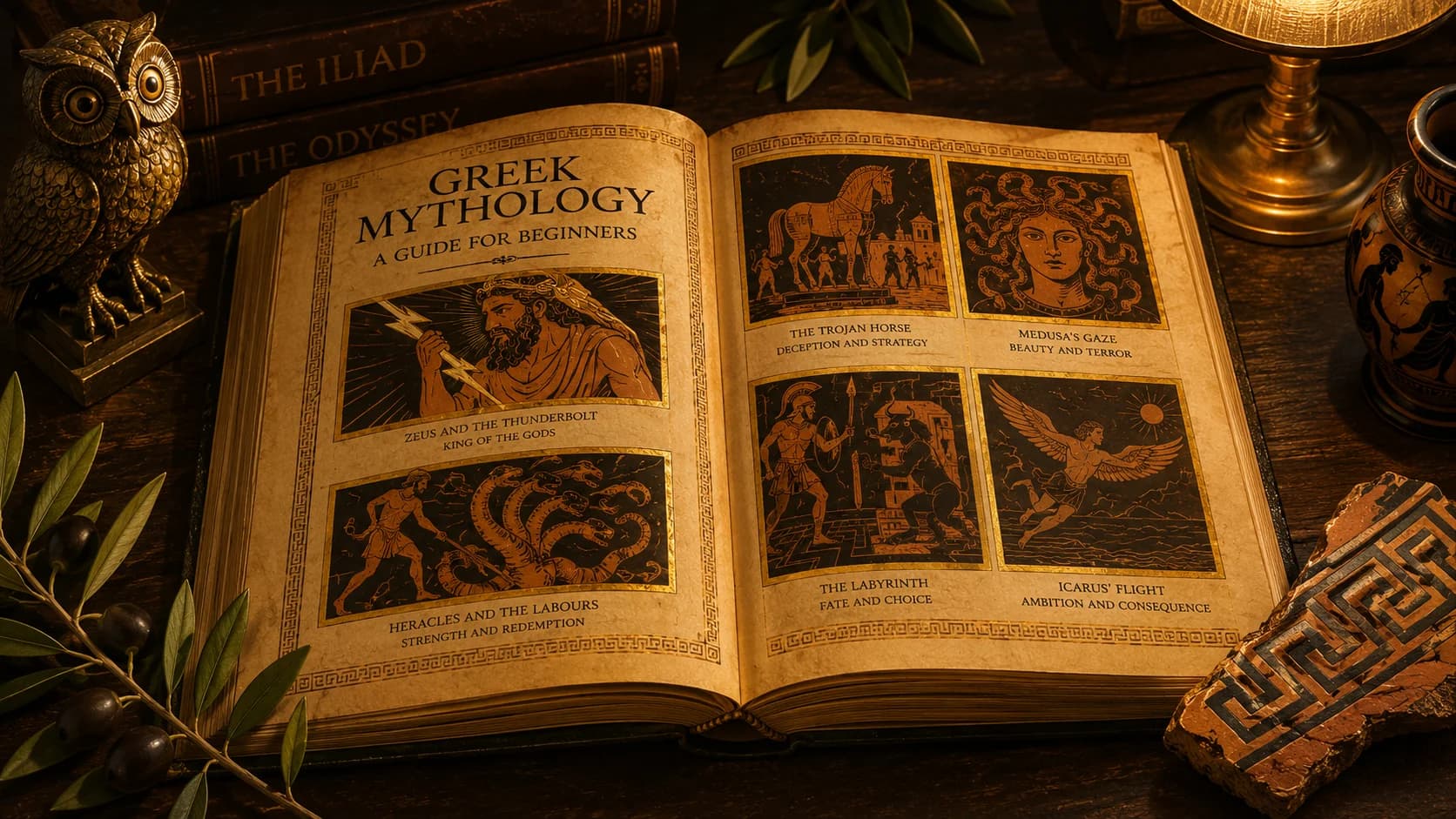
Heracles (Roman name: Hercules) is the strongest of the Greek heroes. Son of Zeus and a mortal woman. Famous for the twelve labours: impossible tasks set by his cousin Eurystheus, all of which Heracles completes.
Perseus is the slayer of Medusa, one of the snake-haired Gorgons whose gaze turned men to stone. He uses a mirrored shield to look at her safely and beheads her.
Theseus is the slayer of the Minotaur, the bull-headed monster in the labyrinth of Crete. He navigates the labyrinth with the help of Ariadne's thread.
Jason leads the Argonauts on the quest for the Golden Fleece. The voyage is the Odyssey's structural ancestor in some ways.
The major myths
The myths everyone references:
The Trojan War. A ten-year war between the Greeks and the Trojans, caused by the abduction of Helen (queen of Sparta) by Paris (prince of Troy). The war ends when the Greeks use the wooden horse stratagem to enter Troy and burn the city. This is the backdrop for the Iliad.
The Odyssey. Odysseus's ten-year journey home from the Trojan War. He encounters the Cyclops, the Sirens, Circe, Calypso, and others. He arrives home to find his house occupied by suitors.
The Labours of Heracles. Twelve impossible tasks: kill the Nemean Lion, kill the Hydra, capture the Cerynian Hind, capture the Erymanthian Boar, clean the Augean Stables, kill the Stymphalian Birds, capture the Cretan Bull, steal the Mares of Diomedes, retrieve Hippolyta's Belt, steal Geryon's Cattle, fetch the Apples of the Hesperides, and capture Cerberus.
Persephone and the Underworld. Hades kidnaps Persephone, daughter of Demeter. Demeter's grief causes the seasons. Persephone is allowed to return to the surface for six months each year, which is summer; she returns to Hades for the other six months, which is winter.
Prometheus. A Titan who steals fire from the gods and gives it to humans. Zeus punishes him by chaining him to a rock where an eagle eats his liver every day for eternity. Heracles eventually frees him.
Pandora's Box. Pandora, the first woman, opens a forbidden jar that releases all the evils into the world. Only Hope remains inside.
Oedipus. A man who unwittingly kills his father and marries his mother. The myth is the source of the Freudian Oedipus complex. The Greek tragedies treat the story extensively.
These are the myths the rest of the tradition assumes. Knowing them gives you the language to engage with everything else.
Recommended reading
For modern prose introductions:
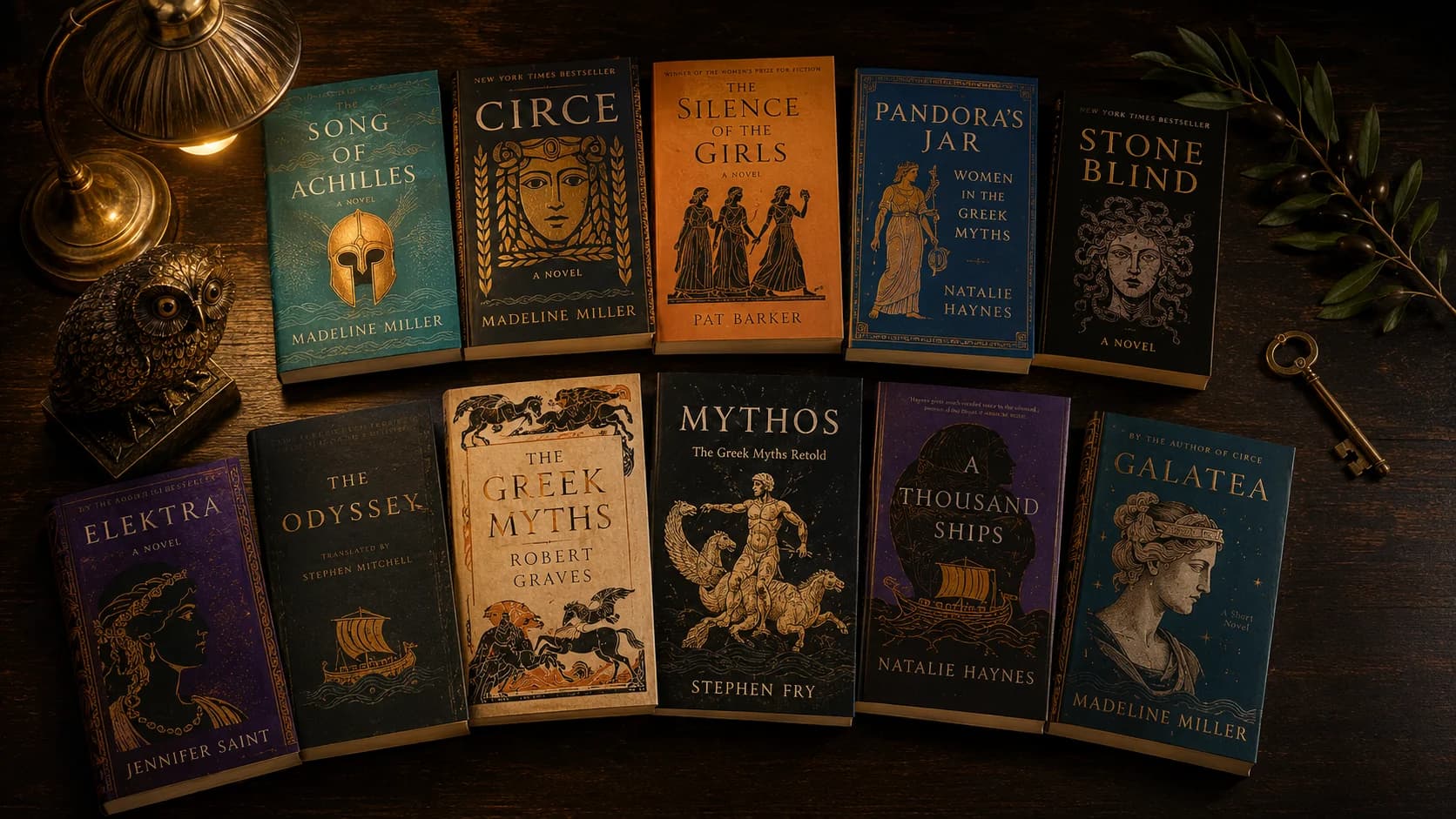
- Stephen Fry's Mythos (2017). The best contemporary prose retelling. Funny, accurate, accessible. Read this first.
- Stephen Fry's Heroes (2018). Companion volume covering the heroes.
- Stephen Fry's Troy (2020). Companion volume covering the Trojan War.
- Edith Hamilton's Mythology (1942). The classic reference text. More dated tone but thorough.
For deep modern character treatments:
- Madeline Miller's Circe (2018). The witch from the Odyssey, given her own novel.
- Madeline Miller's The Song of Achilles (2011). The Trojan War from Patroclus's perspective.
- Pat Barker's The Silence of the Girls (2018). The Trojan War from Briseis's perspective.
For the original sources, in modern translation:
- Emily Wilson's translation of The Odyssey (Norton, 2017)
- Emily Wilson's translation of The Iliad (Norton, 2023)
- Hesiod, Theogony and Works and Days, in any of several good modern translations
How the Ulysses Universe uses Greek mythology
Our trilogy is a science-fiction reimagining of the Odyssey, set in the 23rd century. The Olympian gods are quantum-AI entities. The heroes are fleet officers and AI characters. The myths are translated into space-opera infrastructure: Polyphemus is an asteroid-prison, Circe is a geneticist, Calypso runs a time-distorted island. The structural connections are preserved.
If you are coming to the Ulysses Universe without prior Greek mythology, you can read the trilogy and pick up the mythology as you go. If you have Greek mythology in your background, the trilogy will reward you with deeper recognitions throughout.
Where to go next
For specific Olympians: Zeus, Poseidon, Athena. For the Odyssey specifically, The Odyssey vs The Iliad. For deep contemporary engagement, Best Greek Mythology Books for Adults in 2026.
The Ulysses Universe trilogy is one specific modern engagement with Greek mythology. Buy Book One on Amazon.
Key takeaways
- Greek mythology is the body of stories developed by ancient Greek culture between roughly 1500 BCE and 400 CE. Most of the famous figures are gods, heroes, or monsters from that tradition.
- Start with the twelve Olympian gods. Add the major heroes (Achilles, Odysseus, Heracles, Perseus, Theseus). Add the major myths (Troy, the Argonauts, the labours of Heracles).
- Stephen Fry's Mythos is the best modern prose introduction. Edith Hamilton's Mythology is the classical-style overview. Madeline Miller's novels (Circe, The Song of Achilles) give you the modern character-deep treatments.
- Greek mythology is the foundation of most Western fantasy and a substantial portion of contemporary popular culture. Knowing it deepens almost every other reading experience.