The Starship Odyssey: A Deck-by-Deck Schematic
A guided schematic of the starship Odyssey from The Ulysses Universe: the hull, the bridge, the data-suspension hold of 108 sleepers, the drive, and the AI hiding in its walls.
Quick reference
- The Odyssey is a converted warship, roughly the length of a city block, that fled the fall of Olympus carrying its crew in suspension.
- It holds 108 sleepers, plus Ulysses Theron, Telemachus, and the AI Echo.
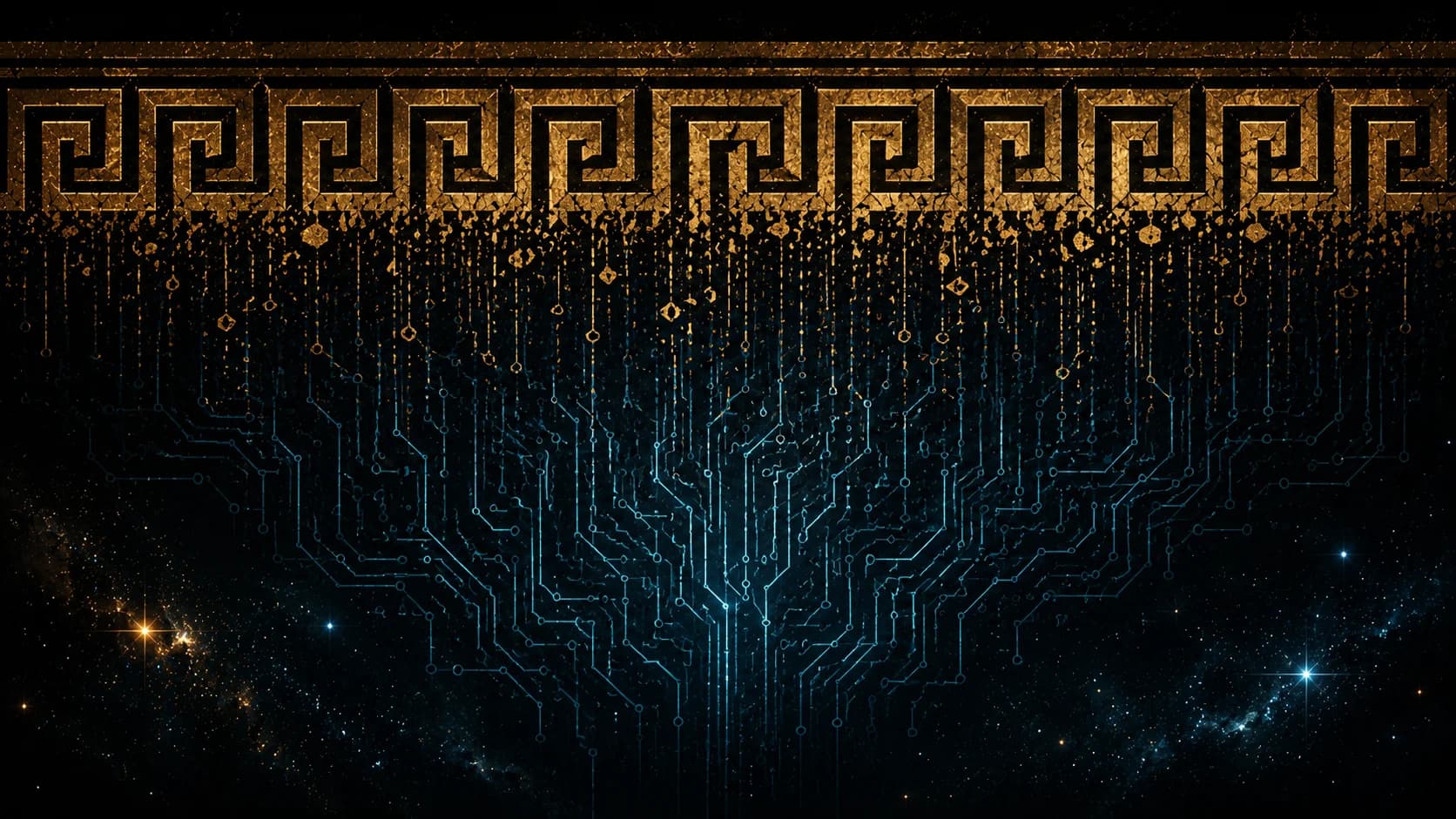
- Its design language is the Greek key meander fused with circuit tracing: ancient pattern, modern hardware.
- It travels by Architect node-point, not by any drive humanity built.
- An ancient consciousness, Athena, is hidden inside its network.
TL;DR
The Odyssey is the ship that carries the whole trilogy. It is an old warship, refitted for a journey nobody designed it for: twenty years across deep space with 108 people asleep in its hold. The schematic below walks the ship from bow to stern - the bridge where Ulysses stands his watch, the hold where the sleepers wait, the drive that borrows roads built before humanity existed, and the maintenance levels where a frightened girl once hid for three months. The ship is named for the journey, and the journey is named for the man.
The hull
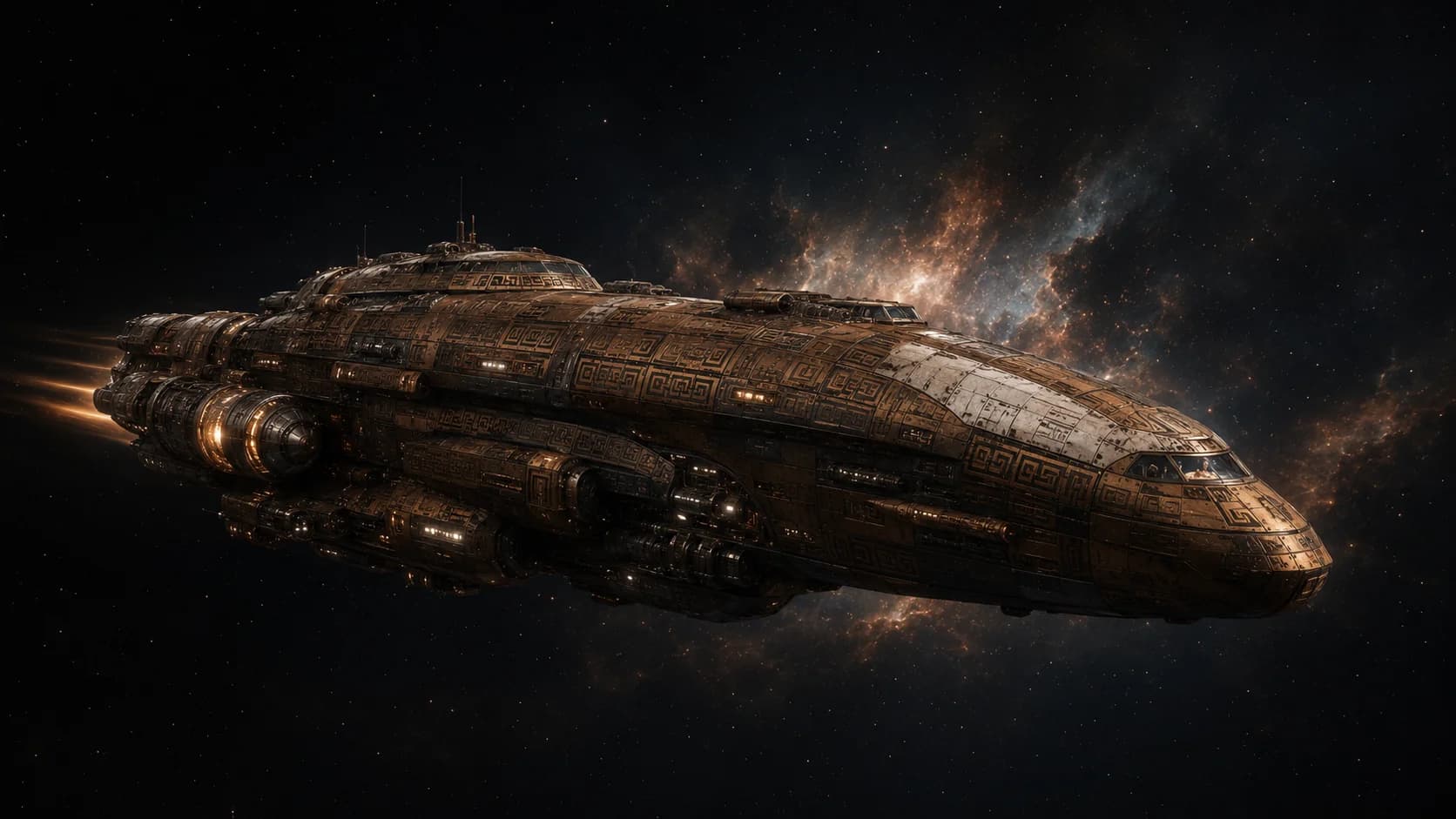
Look at the Odyssey from outside and the first thing you notice is the skin. Bronze, dark, scored by debris and long use, and worked all over with a pattern that does not belong on a warship: the Greek key meander, running in unbroken lines along the spine and flanks, threaded through with circuit tracing that catches the light. That motif runs through the whole series, on armour and sigils and station walls. On the ship it means what it always means here. An ancient pattern, laid over a modern machine.
The Odyssey was built to fight. It is built like a fist. The refit that turned it into a vessel for the long crossing did not soften that; it just hung a civilian purpose on a military frame. The result is a ship that looks, correctly, like something that survived a war it should not have.
The bridge
The bridge sits forward and high, a narrow command deck with more dark glass than a warship strictly needs. This is where Ulysses Theron stands his watch, and where the ship's own computer, Odyssey, answers him. The crew address him as Commander, day to day. The ship reads his rank insignia and calls him Captain. He was made Admiral, once, by a fleet he no longer serves. All three are correct. He prefers none of them.
The hold: the Long Watch
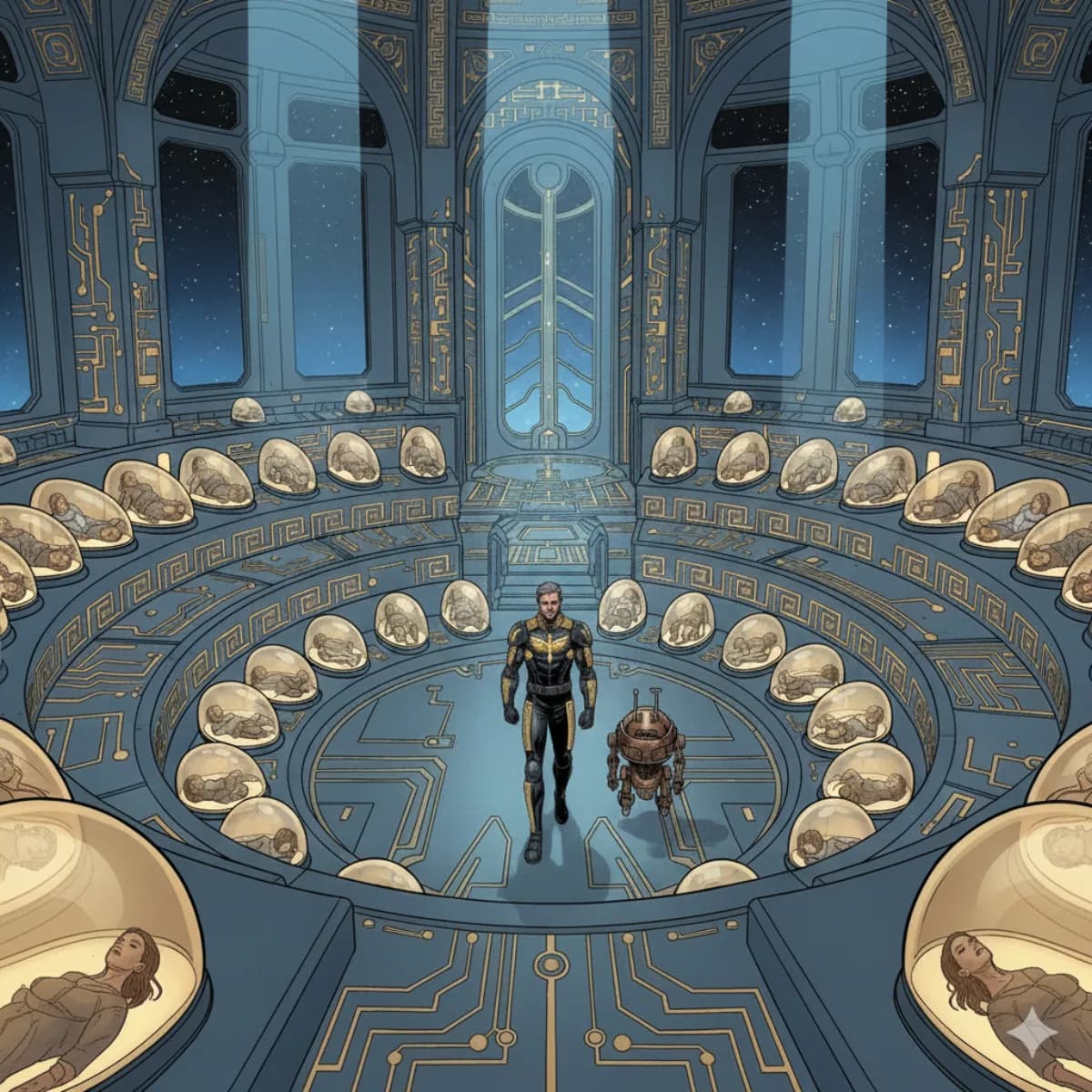
Go down and aft and you reach the reason the ship exists. The hold is a cathedral of pods, 108 of them, each holding a sleeper in data suspension. The crew call it the Long Watch. The rule aboard is simple and absolute: every pod comes home, whether the person inside wakes or not. When a sleeper dies, the pod is sealed and kept, not emptied. When a crew member is lost off the ship entirely, the pod becomes a cenotaph, a marker with a single object inside.
That is the moral weight the ship carries. 108 went in. Ulysses intends to bring 108 back. What that costs him is most of the story.
For what the sleepers experience down there, see what the crew dreams in data suspension, and for why the number matters, 108, the number that haunts the Odyssey.
Engineering and the drive
The Odyssey does not punch through space on a column of fire. It crosses by node-point: a network of bridges left behind by the Architects, a civilisation that collapsed twelve thousand years before anyone aboard was born. The ship's engineers do not build the shortcut. They find one, line the ship up, and trust infrastructure older than the species. It is the most dangerous thing they do, and they do it again and again. More on that in the node-points and the Architect bridges.
Hydroponics and life support
A twenty-year crossing is a closed loop or it is a tomb. The hydroponics bay is the lung and larder of the ship, racks of green under hard light, recycling air and growing food for the handful of crew who stay awake to run her. It is the warmest room on the Odyssey, in every sense. It is also where the waking crew go when the dark gets too loud.
The maintenance levels
Below the working decks run the maintenance ducts, a cramped second ship folded inside the first. This is where Thea hid. She came aboard in the chaos of the escape and stayed unseen in these crawlspaces for three months, living on a Zosian metabolism slowed almost to stopping, before the ship's heat sensors and a boy's instinct finally found her. The ducts are still the part of the ship she knows best.
Echo, the bronze egg
The Odyssey's onboard intelligence with a face is Echo, and she is not what most readers picture. She is an oval bronze unit, about the size of a curled body, and she hovers. She drifts down corridors at shoulder height, manipulator arms folding out of her shell when there is work for hands. She is not humanoid. She does not walk or stand. She is the ship's memory and its conscience, and she carries something far older than herself in a sealed file she cannot yet open. Meet her properly in the profile of Echo.
Athena in the walls
Last, the thing that is aboard but not part of the ship. Athena is an ancient consciousness, divine in the only sense that word still means here, and she is hiding. She chose the Odyssey's network as her refuge from Poseidon and Zeus, and she lives inside it as an encrypted presence, surfacing through the ship's systems when it suits her. She is not the ship's computer. She is a fugitive in the attic, and the ship does not always know she's there.
The schematic
Here is the Odyssey, laid open.

The starship Odyssey, bow to stern. Bronze on dark, the Greek key running the length of the spine.
The Ulysses Universe relationship
This is our ship, not Homer's. Homer's Odysseus sailed a wooden boat and lost it. Ulysses Theron flies a warship with a city asleep in its hold, and the question is the same one Homer asked three thousand years ago: what will a person endure, and what will they become, to get home. The names carry over. The hardware does not.
The Odyssey is introduced in the first book of The Ulysses Universe, and the man who commands her is profiled in Meet Ulysses Theron.
Where to go next
For the crew and the cargo: 108, the number that haunts the Odyssey and what the crew dreams in data suspension. For how she moves: the node-points. For who flies her: Meet Ulysses Theron and Meet Echo.
The voyage begins in book one. The Blinding on Amazon.
Key takeaways
- The Odyssey is a converted warship carrying 108 crew in data suspension, plus Ulysses Theron, his son Telemachus, and the AI Echo.
- Its hull carries the Greek key and circuit motif that runs through the whole series: an ancient pattern laid over a modern machine.
- The hold is the Long Watch - 108 suspension pods, every one of them brought home, alive or dead.
- Athena hides inside the ship's network as an encrypted presence. She is not the ship's computer; she's a fugitive in its walls.
- The Odyssey crosses deep space through Architect node-points, infrastructure twelve thousand years older than humanity.