The Sleeping Crew: Mira Santos and the 108
She's a name on a manifest. Pod 1 of 108. Twenty years of dreaming. A profile of one of the suspended crew - and what it means to be one of the many the trilogy doesn't get to introduce.
A name on a manifest
There is a manifest in the Odyssey's bridge logs. It lists 108 names. Mira Santos is the third entry.
The list is alphabetical by surname, except for the first two which are command-priority assignments. Mira's name sits below those two, in the position that any alphabetical sort would put a "Santos" with no political weighting.
That is, in one sense, all we know about her directly. A name. A pod number. A position on a manifest.
In another sense, it is most of what there is to know about anyone after twenty years.
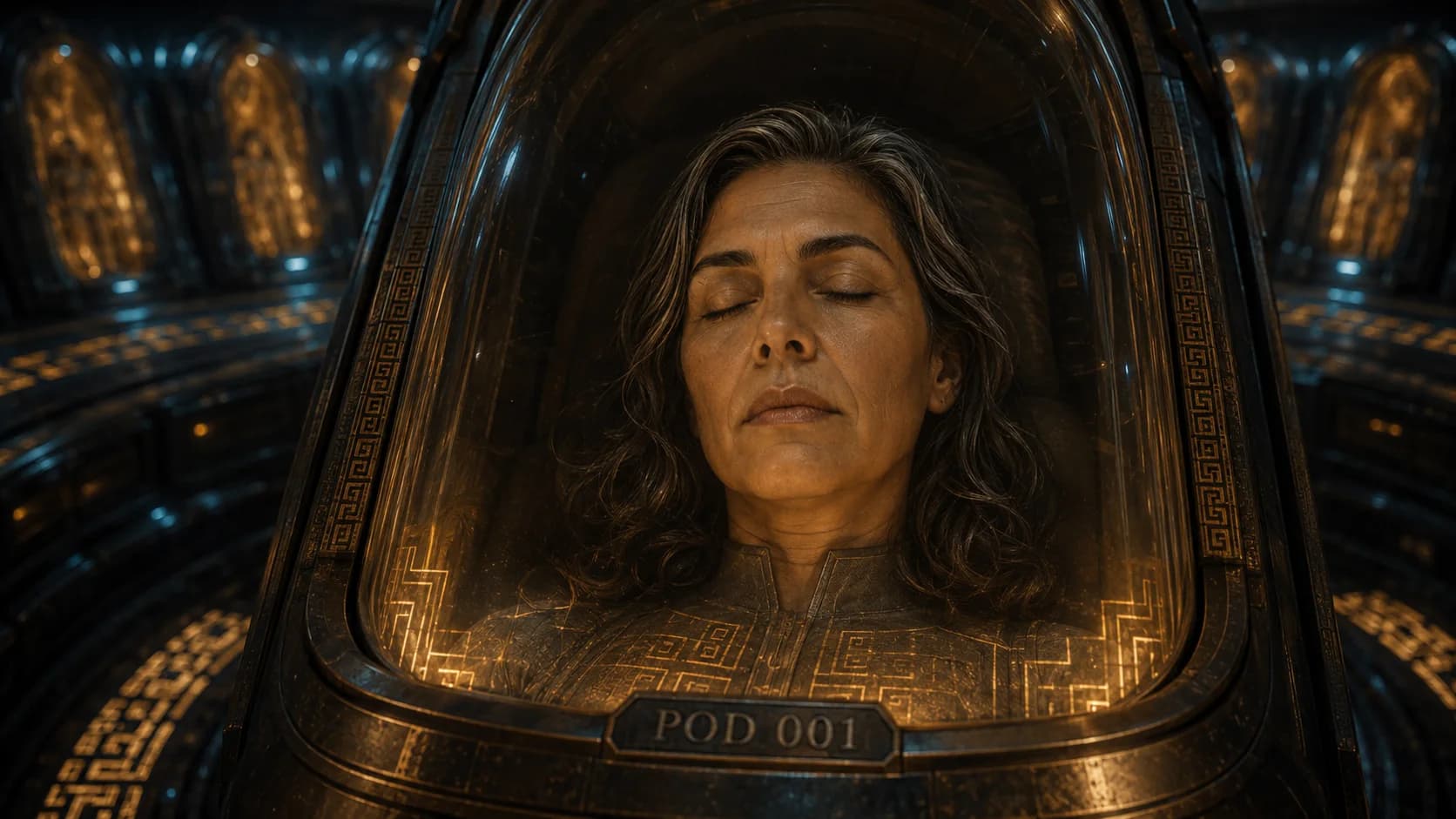
Pod 1
Her pod is in the centre ring of the Suspension Chamber. Pod 1. The position is administrative rather than honourary. The numbering was assigned at boot when the chamber was first commissioned, before any of the cursed crew had taken their places. Pod 1 happened to be Mira's because the alphabetical sort put her there.
The Suspension Chamber holds 108 such pods, arranged in concentric rings around a central walkway. From the chamber's main entrance, Pod 1 is the first you pass. Most of the active crew has touched its glass at some point. It is a small ritual the trilogy never describes directly. Walking past Pod 1 with your fingertips trailing along the cool surface, the way you might touch a friend's shoulder.
She does not wake when you do this. She is not aware of the contact. The pod's pattern-holding systems do not register tactile input from outside the glass. You touch the pod for your own sake. The pod has not asked you to.
What we are allowed to know
The trilogy keeps Mira's biography sparse on purpose.
She was on Olympus Station during the events of Year 0. She had reason to flee with the Theron family rather than stay. She was admitted to the Odyssey's complement during the chaos of the 47 seconds. She entered Pod 1 within hours of lift.
We do not know her age. We do not know what she did on Olympus before she fled. We do not know if she had family there, or here, or anywhere. We do not know what voice she had, what she laughed at, what she could not let go of.
These omissions are not accidents. The trilogy is being careful with her. There are 108 lives in suspension and the foreground narrative cannot afford to tell all 108 stories. So it picks a representative - one name, one face through the glass - and lets the reader carry the weight of the other 107 by inference.
The active crew's bond with the sleepers
Ulysses visits the Suspension Chamber after every tactical decision. This is by Book 1 a ritual of his. Every fork in the journey, every cost imposed by the gods, every loss they cannot recover from - he goes to the chamber and walks the rings.
The walking is not a planning exercise. It is an accountability one. He is reminding himself who is here. He is touching pods. He is reading the names on each plaque, slowly, even though he knows them.
Some of the names mean specific things to him. Petrov's wife Elena, in Pod 47. The cargo officer in Pod 23 whose son was just twenty when he was suspended. The medical assistant in Pod 76 whose laugh used to fill the mess hall at breakfast.
Mira's name does not, as far as the trilogy tells us, mean anything specific to him. He did not know her on Olympus. He has not had occasion to speak with her family. She is, to him, one of the many - which is the same as everyone she stands in for.
The bond between active crew and sleepers is the trilogy's quietest sustained theme. Ulysses is responsible for getting them home. They are responsible for being there when he does.
What suspended consciousness might be
We have written elsewhere about the ambiguity of suspended consciousness in the Ulysses Universe. Data Suspension: What the Crew Dreams lays out the two readings. Some passages suggest the suspended mind is genuinely active, dreaming, possibly even in contact with other suspended minds. Other passages suggest the mind is genuinely paused, with no subjective experience and no internal time.
The trilogy does not commit to one reading.
For Mira specifically, this ambiguity has weight. If she is dreaming for twenty years, we have no idea what she dreams about. If she is paused for twenty years, she will wake having lost no subjective time at all - the journey will not have happened, from her perspective, even though it took everything from the people who carried her through it.
Neither version is comforting. Both versions are part of what the trilogy is asking the reader to sit with.
Why Mira and not someone else
The trilogy could have picked any of the 108 to use as the representative sleeper. The fact that it is Mira Santos and not Williams or Chen or Okonkwo is not, ultimately, important. The choice is interchangeable.
What is important is that the choice was made at all. The trilogy commits to one name from the 108 and lets her stand for all of them. The act of choosing one face to show is a way of acknowledging that there are 107 faces it does not have time to show.
This is the kind of move that distinguishes a careful adventure narrative from a careless one. The careless version would simply say "108 souls" and never name them. The careful version names one and uses her to say what cannot be said about the rest.
Mira Santos is, in this reading, the trilogy's quietest character. The one who has the least to do and the most to mean.
What the active crew owes her
She is one of 108. The active crew is currently around twelve. The math is not symmetrical. The few are carrying the many. The many cannot help.
Ulysses understands the math. He has been understanding the math for twenty years.
The trilogy's longest sustained argument, beneath everything else, is that you do not stop carrying people just because they cannot carry themselves. Mira is in Pod 1 because she chose to flee Olympus with the Therons rather than stay. That choice obligates the people who are still awake.
Whether the obligation is repayable is a question the trilogy lets the reader answer for themselves.
Where to read more
For the broader 108-souls premise and the curse mechanics: Data Suspension: How the Curse Works. For the ambiguity about what suspended minds experience: Data Suspension: What the Crew Dreams. For the symbolic weight of the number 108 across the trilogy: 108: The Number That Haunts the Odyssey.
For the moment Mira and the rest of the 108 entered suspension: The 47 Seconds: The Olympus Escape.
For the man who walks past her pod every shift: Meet Ulysses Theron: The Admiral Who Blinded a God.
Book 1: The Blinding opens with the curse already in effect. Mira is already in Pod 1 when the book begins. Buy Book One on Amazon.
Key takeaways
- Mira Santos is one of the 108 cursed crew who fled Olympus Station with Ulysses Theron in Year 0. She has been in data suspension throughout the journey.
- Pod 1, in the centre ring of the Suspension Chamber. Her face is one of many that the active crew passes every shift.
- She is, in the trilogy's framing, one example of the larger truth: there are 108 stories the journey carries that the foreground narrative does not have time to tell.
- The bond between the few who are awake and the many who are not is one of the trilogy's quietest themes. Mira stands in for all of it.